 Vora

Some apparent contradictions are different rules
The notice period might vary by appointment type. One rule could apply to a particular branch, while the other applies to the rest of the business. A future policy may already be written but not yet effective.
Put the competing statements next to their conditions. Record the service, location, audience and relevant date. Look for wording that changes the customer's obligation, including qualifiers outside the retrieved paragraph.
In the hypothetical example, the business owner might establish that 48 hours applies only to visits requiring rented equipment. Both statements can remain valid once their scope is explicit. The assistant then needs to establish the visit type before answering.
If both documents govern the same visit at the same time, the conflict remains. Do not ask the customer to choose which policy the business should apply.
Give each subject a business owner
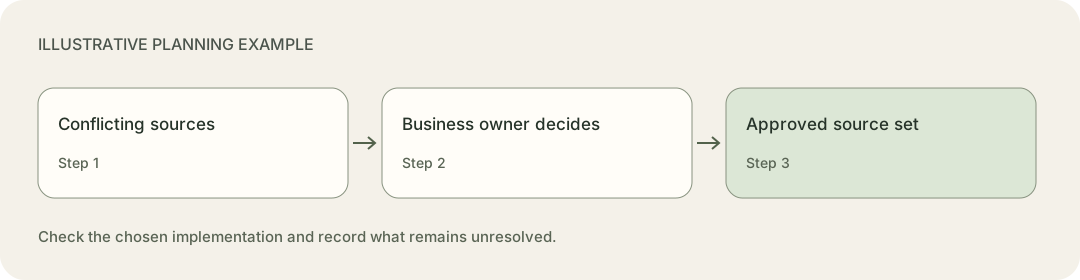
An agency can implement a precedence rule, but the client must approve what it means. Ask who can decide the answer for the topic, and which source records that decision.
Avoid one universal rule such as "the website always wins". The website may own public service descriptions while an operational system owns appointment status. Staff notes can explain a problem without authorizing a customer promise.
| Subject | Proposed controlling source | Required scope | Who resolves a conflict? |
|---|---|---|---|
| Public service description | Approved service catalogue | Service and location | Service owner |
| Appointment-change policy | Approved policy record | Appointment type and effective period | Operations or policy owner |
| Current appointment status | Scheduling system used by staff | Correct booking and authorized customer | Scheduling team |
| Current listed price | Approved price record | Item, currency and applicable conditions | Commercial owner |
| An approved exception | Recorded exception decision | Exact request and permitted use | Person authorized to grant that exception |
Treat these as starting roles to agree with the client. A small business may assign several to one person. What matters is that a disagreement has a named destination and a decision can reach the assistant's active sources.
The broader knowledge-readiness review checks whether those owners and sources exist before a build begins. This register handles the cases where approved-looking material already disagrees.
Keep approval time separate from effective time
A document's modified timestamp tells you that something changed. It does not establish when its policy begins or which customers it covers.
Record the effective start and, where relevant, end of a rule. Preserve its approval state and the version it replaces. A future policy should not answer a question about today's service merely because someone uploaded it yesterday.
Historical questions also need a clear boundary. If the assistant is meant to explain the policy applicable to an earlier appointment, retain the approved version history with its scope. If it handles only new enquiries, exclude historical versions from that answer path while preserving them in the appropriate archive.
Do the same for exceptions. "The manager allowed this once" is not a general policy update. Record the request or group the exception applies to, who approved it and any expiry. Keep it out of unrelated customer answers.
When facts change continually, use the relevant current-facts review. A document precedence rule cannot make yesterday's stock count current.
Search ranking should work inside the approved source set
Semantic search helps locate material that relates to a question. Its score should not be treated as a vote on which department has authority.
Microsoft describes Azure AI Search's semantic ranker as reranking results by semantic relevance to the query. That is useful for finding a passage. It does not, by itself, express the client's policy approval decision. The latter is a separate business rule you must supply. Microsoft's semantic ranking overview describes what the score represents.
Where the retrieval system permits it, attach source metadata and restrict the eligible material before selecting an answer. OpenAI's retrieval API, for example, supports file attributes and attribute filtering. Those features can carry an application's source categories; they do not decide which business policy is authoritative. OpenAI's retrieval guide documents the filtering capability.
For your application, useful fields may include approval state, service, location, effective period and source identifier. Decide how to represent mixed-scope documents: one file containing both draft and approved policies may need to be separated before a file-level filter is useful.
Inspect the eligible sources in tests. A prompt that prefers current policies is weaker evidence than a retrieval result showing the expected policy and excluding an out-of-scope version. Access restrictions must also hold for the requesting user, regardless of which policy ranks highest.
Record the decision and fix its copies
When an owner resolves a conflict, create a short decision record. Include the customer question, competing statements and source links. Add the approved answer, its scope, effective period, owner and the old material that needs removal from the active answer set.
Then follow the change through the places customers and staff use. Updating the source document leaves unfinished work if the website, a translated page or a retrieval index still exposes the old answer.
In the hypothetical notice-period case, write the equipment exception into both the public explanation and the approved policy. Check how a customer learns which appointment type they have. If that information is available only to staff, the chatbot may need a handoff instead of another clarification question.
Avoid storing the resolution only in a chat between the agency and the client. Whoever maintains the knowledge base next needs to know why the answer changed and which version is active.
Leave unresolved questions out of the answer set
Sometimes the client cannot choose an owner during the review. Keep the disputed question visible as unresolved, with a person responsible for the next decision. Do not turn the absence of an objection into approval.
The customer response can stay brief: "I need the team to confirm the notice period for that appointment." Use that wording only with a working fallback and handoff method. The handoff should identify the conflicting sources so staff do not repeat the same search.
Test the resolved rule with the exact disputed question, a different wording and a nearby case where another rule should apply. Also test a question with the missing scope detail. Record the expected source and answer before running the cases; inspect what was retrieved afterward.
If this is part of your first-client deliverable, put unresolved policies in the scope agreement. You can deliver the approved question set while a disputed topic stays with the client, provided that boundary is explicit and tested.
Bring the next conflict to the owner as a decision to make: "These two sources govern the same appointment. Which statement applies, from when, and where should we record it?" Keep that answer attached to the policy the assistant will use.